GEOTECHNICAL ENGINEERING
HOUSTON
HomeLaboratoryAtterberg limits

Atterberg Limits Testing in Houston: The Clay That Engineers Can’t Ignore

Evidence-based design. Reliable delivery.

LEARN MORE

Drive from Katy to the Heights and you'll feel it—the soil changes. In Katy, you might see sandy loams that drain well, but move east toward Buffalo Bayou and you hit those dark, sticky Beaumont clays that gum up a backhoe bucket in minutes. Houston’s geology is a patchwork of Pleistocene terraces and recent alluvial deposits, which means the plasticity of the soil can shift drastically within a single project footprint. That’s where Atterberg limits testing becomes essential. Over the years, our lab has processed thousands of samples from sites across Harris County, from the Energy Corridor to Clear Lake, and the one constant is variability. Getting reliable liquid limit, plastic limit, and plasticity index values isn’t just about ASTM compliance—it’s about understanding how Houston’s clay will behave when the summer drought shrinks it to a brick, or when a tropical storm saturates it for a week. Before you commit to a foundation type, work with a lab that knows the difference between a 30-PI clay from Spring and a 60-PI fat clay from Montrose. And for sites where the clay strata is deeper, we often coordinate with SPT drilling to correlate Atterberg results with blow counts at depth.

In Houston, a plasticity index above 35 means you’re designing for movement—the only question is how much.
Our service areas

Process overview

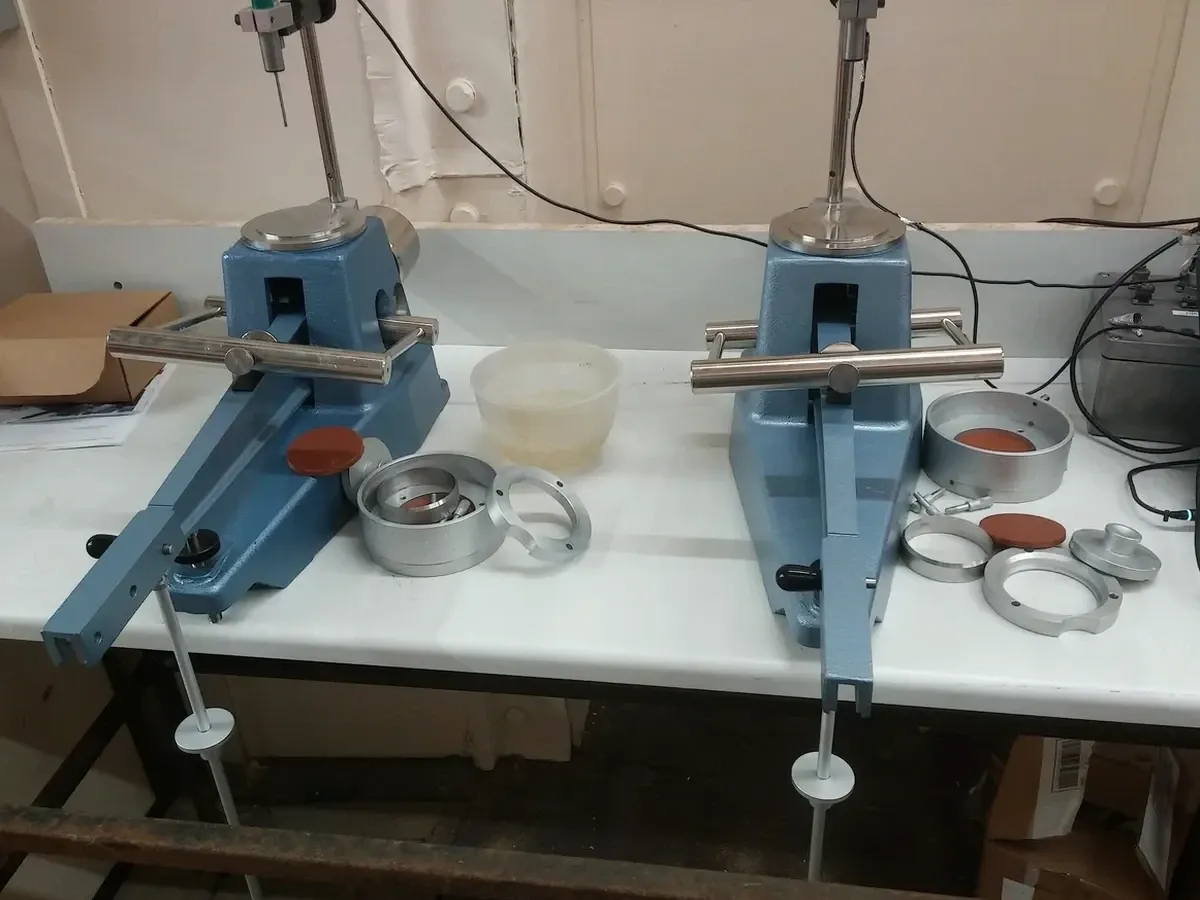
One thing we’ve noticed after years of working Houston soils: the plastic limit test trips up more technicians than any other. It’s not just rolling threads to 1/8 inch—the ambient humidity in a Houston lab in August can mess with your moisture conditioning if you’re not careful. Our team runs Atterberg limits under strict ASTM D4318-17e1 protocol, with all samples oven-dried and passed through a No. 40 sieve before testing. We see a lot of high-plasticity clays (CH) in the inner loop where old fluvial deposits dominate, while out toward Tomball and The Woodlands, you start getting more low-plasticity silts and lean clays. The shrinkage limit is particularly relevant here because Houston’s seasonal wet-dry cycles are brutal on expansive soils—we’ve pulled samples that lost 15% volume from field moisture to oven-dry condition. Every report includes Casagrande cup liquid limit, thread-rolling plastic limit, and calculated plasticity index, plus a USCS classification so your geotechnical engineer can make immediate decisions on bearing capacity and swell potential. If the fines content is high, we also recommend running a grain size distribution to complete the soil profile.
Atterberg Limits Testing in Houston: The Clay That Engineers Can’t Ignore
Technical reference — Houston

Local context

The humidity along the Gulf Coast doesn't just make Houston summers uncomfortable—it fundamentally alters how soil behaves. When a fat clay from the Beaumont Formation remains at 90% saturation for months before baking under a July sun, the shrink-swell cycle can destroy slab-on-grade foundations within a single season. We've observed driveways in Meyerland rising two inches between June and September because the Atterberg limits weren't assessed before pouring. The danger isn't limited to vertical movement; lateral earth pressures on retaining and basement walls shift significantly as the soil changes from semi-solid to plastic. If your geotechnical report lacks Atterberg limits paired with moisture content profiles across different seasons, you're essentially estimating swell pressure and volume change potential. For any structure in Houston east of Highway 6, where the clay becomes heavier and deeper, omitting this test guarantees forensic engineering calls five years down the line.

Need a geotechnical assessment?

Reply within 24h.

Email: contact@geotechnicalengineering1.org

Reference standards


The relevant testing and classification standards include ASTM D4318-17e1 for liquid, plastic limits, and plasticity index; ASTM D2487-17e1 for soil classification using the Unified System; IBC 2021 Section 1803.2 for expansive soils; and TxDOT Tex-104-E for determining plasticity index.

Technical data

ParameterTypical value
Liquid Limit (LL) Range, Houston Clays35% – 85%
Plastic Limit (PL) Range, Houston Clays12% – 28%
Typical Plasticity Index (PI)20% – 65%
Shrinkage Limit (SL)8% – 18%
Test StandardASTM D4318-17e1
Sample Preparation SieveNo. 40 (425 µm)
USCS Classification OutputCL, CH, MH, ML
Typical Turnaround3–5 business days

Questions and answers


What are Atterberg limits and why do they matter in Houston?

Atterberg limits define the moisture content boundaries at which a fine-grained soil shifts between solid, semi-solid, plastic, and liquid states. In Houston, where expansive Beaumont and Lissie Formation clays are prevalent in the near-surface geology, the liquid limit and plasticity index precisely indicate how much the soil will shrink and swell with seasonal moisture changes. A plasticity index exceeding 35—common in samples from the inner loop and east Houston—signals high expansion potential that must be accounted for in foundation design.

How much does an Atterberg limits test cost in Houston?

In our Houston lab, a standard Atterberg limits test (covering liquid limit, plastic limit, and plasticity index) on a single sample typically costs US$60 to US$80. For rush turnaround or combined packages that also include grain size analysis and USCS classification, pricing is adjusted accordingly. We recommend contacting us in advance for volume discounts on projects involving multiple samples.

How long does it take to get Atterberg limits results back?

Standard turnaround is three to five business days after sample receipt, provided the sample arrives in a sealed container at field moisture. For active construction projects awaiting foundation decisions, we can often expedite results to within 24–48 hours.

How do plastic limit and liquid limit relate to foundation design?

The plasticity index—the difference between the liquid limit and plastic limit—serves as the best single-number predictor of soil movement. A high-PI clay like those in Houston's Energy Corridor can background volume changes of 10% or more between wet and dry seasons. Foundation engineers use that number to select pier depth, slab reinforcement, and moisture barrier strategies. Additionally, the liquid limit alone correlates with settlement potential under load.

Can you run Atterberg limits on samples from outside Houston?

Yes, we welcome samples from across Southeast Texas—including Beaumont, Conroe, Richmond, Galveston—and even Louisiana. Our lab follows ASTM D4318-17e1 regardless of sample origin, and we are well-versed in the regional geology from the Brazos River basin to the Sabine. For shipping, simply seal the sample in a moisture-tight container and include chain of custody documentation.

Location and service area

We serve projects across Houston and surrounding areas.

View larger map