GEOTECHNICAL ENGINEERING
HOUSTON
HomeInvestigationCPT (Cone Penetration Test)

CPT (Cone Penetration Test) in Houston: Continuous Soil Profiling for Gulf Coast Geotechnics

Evidence-based design. Reliable delivery.

LEARN MORE

ASTM D5778 governs the Cone Penetration Test, and in Houston the methodology proves indispensable for characterizing the city's notoriously variable subsurface. The metro area sits atop a complex sequence of Pleistocene Beaumont Formation clays interbedded with overconsolidated sands and silts, deposited by ancient fluvial systems during sea-level highstands. These deposits create a layered profile that standard split-spoon sampling often misses. CPT provides a near-continuous record of tip resistance and sleeve friction, allowing our technical team to detect thin sand seams that act as drainage paths accelerating consolidation settlement. For projects extending into the expansive, high-plasticity clays west of the Grand Parkway, the pore pressure dissipation data from piezocone testing helps quantify consolidation rates that dictate surcharge and wick drain design. This information is critical when evaluating liquefaction potential in loose, saturated fine sands mapped within the 100-year floodplain, and it also informs the selection of deep foundations where soft organic silts exceed 15 feet in depth.

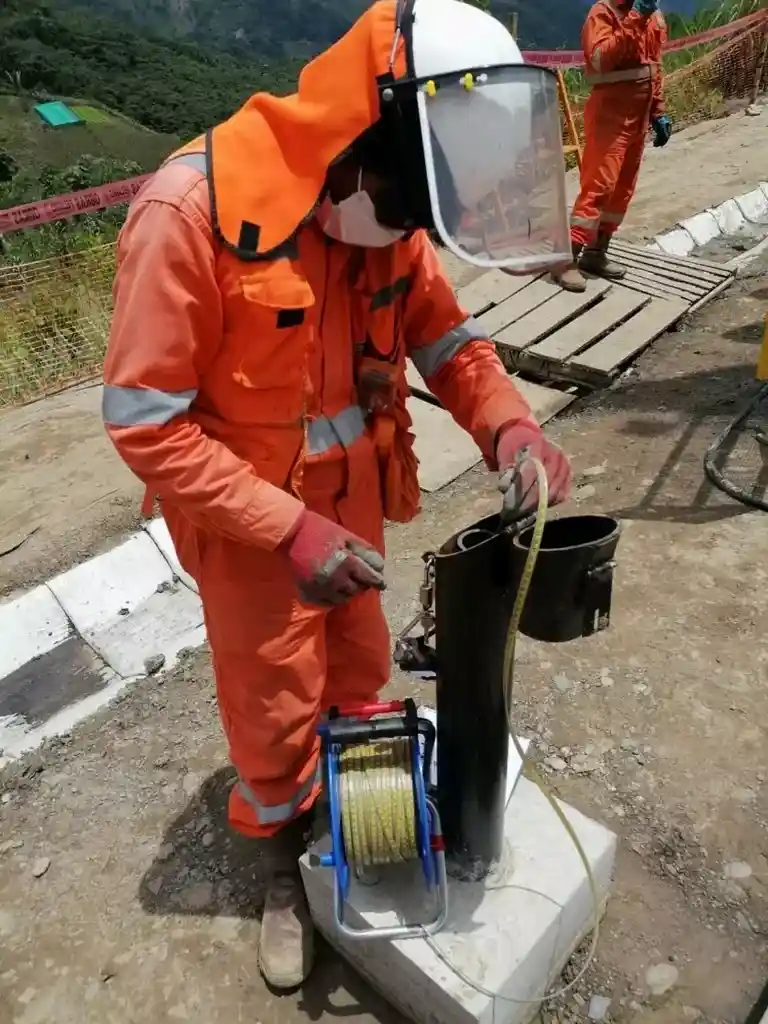
A single CPT sounding in Houston replaces multiple boreholes for stratigraphic definition, delivering qc, fs, and equilibrium pore pressure in one continuous push.
Our service areas

Process overview

Houston's 665 square miles of incorporated land conceal a subsurface shaped by the meandering bayous of Buffalo, White Oak, and Brays. With over 2.3 million residents and a construction pace that routinely ranks among the fastest in the nation, the demand for rapid, accurate site characterization has never been higher. CPT testing in Houston eliminates the sample disturbance inherent in drilling through the stiff, desiccated crust that caps the Beaumont clay. Our 20-ton digital penetrometer pushes a 15 cm² cone at a constant 2 cm/sec, logging qc, fs, and u2 at 2-5 cm intervals through depths exceeding 100 feet. The normalized Soil Behavior Type charts derived from these readings differentiate the city's compressible CH clays from the interlayered CL silts and SM sands without the delays of laboratory turnaround. For contaminated sites in the Ship Channel area, the cone's continuous sleeve measurement reveals the thickness of fill and the depth to natural ground far more reliably than auger observation. This data stream integrates directly with seismic site classification workflows, where Vs profiles are correlated from CPT-derived small-strain shear modulus for ASCE 7 site class determination.
CPT (Cone Penetration Test) in Houston: Continuous Soil Profiling for Gulf Coast Geotechnics
Technical reference — Houston

Local context

Foundation problems often occur in Houston when engineers assume a uniform clay deposit, basing their design on merely two or three boreholes at 100-foot centers. A hidden sand lens within the Beaumont Formation establishes a preferred drainage path; consolidation settlement then completes in 18 months rather than 15 years, and differential movement between adjacent columns causes slab-on-grade cracks. This blind spot is eliminated by CPT because the friction ratio anomaly at a sand seam, though only inches thick, is clearly apparent in the continuous log. A more significant danger is completely disregarding pore pressure. The piezocone tracks excess pore water pressure during penetration; in the normally consolidated clays south of I-10, elevated positive u2 values identify areas where the soil is still settling under its own weight. Creating a mat foundation without that dissipation data leads to long-term settlement that post-tensioning alone cannot remedy. Equally important is identifying gas-charged sediments, frequent in Pleistocene valley-fill deposits: the cone reveals erratic low tip resistance spikes that caution against reduced bearing capacity before excavation starts.

Need a geotechnical assessment?

Reply within 24h.

Email: contact@geotechnicalengineering1.org

Reference standards


Essential standards for CPT work include ASTM D5778-21, ASTM D6067/D6067M-17 (dedicated to Piezocone Calibration), ASCE 7-22 (which uses CPT for Site Class determination), FHWA-NHI-16-072 (applying CPT in LRFD), the TxDOT Geotechnical Manual (2022) CPT section, and ISO 22476-1:2022.

Technical data

ParameterTypical value
Test StandardASTM D5778-21
Cone Capacity20 tons (200 kN)
Cone Area Ratio10 cm² or 15 cm²
Sleeve Area150 cm² or 225 cm²
Penetration Rate20 ± 5 mm/sec
Typical Depth (Houston)60 to 120 ft
Pore Pressure ElementMid-face (u2)
Sampling Interval2 to 5 cm
Data Channelsqc, fs, u2, inclination

Questions and answers


What is the typical cost range for a CPT sounding in the Houston metro area?

CPT testing rates in Houston typically range from US$150 to US$280 per sounding. The final cost depends on the total depth, mobilization distance throughout the metro area, and whether extra modules such as seismic cone or dissipation tests are included. A standard 60-foot push at an accessible west-side site will be near the lower limit; deep soundings exceeding 100 feet with pore pressure monitoring in the Ship Channel area approach the upper bound.

How does CPT replace standard penetration testing (SPT) in Houston clays?

Sample disturbance that regularly affects SPT in Houston's Beaumont Formation clays does not occur with CPT. The cone continuously measures sleeve friction, producing a true friction ratio that identifies soil behavior type without the retrieval issues of a split spoon. For engineering design, CPT-derived parameters are directly input into pile capacity methods such as LCPC and ICP, which are calibrated against cone resistance rather than blow counts, resulting in more dependable unit skin friction values for layered profiles.

Can CPT penetrate the stiff desiccated crust common in Houston?

Yes. Our 20-ton penetrometer can handle the overconsolidated surface crust—which is typically 5 to 15 feet thick with undrained shear strengths exceeding 2,000 psf—without pre-drilling in most cases. Should calcareous nodules or ironstone concretions in the Beaumont Formation pose a refusal risk, we pre-auger through the hard layer and then seat the cone in undisturbed material below, ensuring uninterrupted data from the zone of engineering interest.

What soil parameters can be directly derived from a CPT log for Houston projects?

Primary outputs from CPT consist of corrected cone resistance (qt), sleeve friction (fs), and pore pressure (u2). From these we calculate: undrained shear strength (Su) using an Nkt factor calibrated to local Beaumont clay; relative density (Dr) for sands; constrained modulus (M) for settlement analysis; and soil behavior type (SBT) by way of normalized charts. When SCPTu is used, shear wave velocity (Vs) and small-strain shear modulus (Gmax) are recorded directly.

Does CPT data satisfy City of Houston permitting and TxDOT requirements?

Indeed. Provided a geotechnical report signed by a licensed engineer is included, the City of Houston accepts CPT data under the current building code. TxDOT's Geotechnical Manual explicitly approves CPT for bridge foundation design, embankment stability, and pavement subgrade characterization. Our reports contain the required calibration certificates (ASTM D6067), zero readings, and post-test baselines that both agencies demand in the submission package.

Location and service area

We serve projects across Houston and surrounding areas.

View larger map