GEOTECHNICAL ENGINEERING
HOUSTON
HomeImprovementVibrocompaction design

Vibrocompaction Design for Houston’s Soft Gulf Coast Soils

Evidence-based design. Reliable delivery.

LEARN MORE

The soil profile shifts dramatically between Houston’s east side and the Energy Corridor. Near the Ship Channel, you hit soft, normally consolidated clays within 15 feet. In Katy, the upper sands are thicker but often loose, with SPT N-values below 8. That contrast means a vibrocompaction design that works in Bear Creek won’t necessarily transfer to Pasadena. We’ve seen it firsthand. The challenge in Houston isn’t just settlement. It’s differential settlement across a single pad. When one corner of a warehouse sits on 20 feet of Pleistocene sand and the other hits Beaumont clay, the structure starts working against itself. We combine CPT logs with borings to map the transition zones before laying out the compaction grid. That step alone has saved projects from post-construction litigation. In areas where the sand layer is thin, we often integrate stone columns as a hybrid approach to transfer loads deeper.

Houston’s hidden risk is differential settlement where Pleistocene sands pinch out against Beaumont clay — vibrocompaction design must bridge that transition.
Our service areas

Process overview

IBC Chapter 18 and FHWA-NHI-06-089 drive our design parameters here. Houston sits in a low-seismicity zone, so ASCE 7 site class determinations rarely govern. The real driver is long-term creep settlement under sustained loads. Vibrocompaction design in Houston targets relative densities above 70% in the treatment zone, verified with post-treatment CPT soundings at every fourth probe location. We specify vibrator power based on the grain-size distribution from ASTM D2487 classification. For silty sands with fines content between 12 and 18 percent, water flush helps but doesn’t solve everything. The energy has to be adjusted. In Houston’s summer heat, the water table sits around 8 to 12 feet, which helps the vibro process but complicates verification if not accounted for in the spec. We also factor in proximity to existing structures. Peak particle velocity limits are tight in Midtown and the Museum District — we’ve designed compaction sequences that stay under 0.5 in/sec at 50 feet.
Vibrocompaction Design for Houston’s Soft Gulf Coast Soils
Technical reference — Houston

Local context

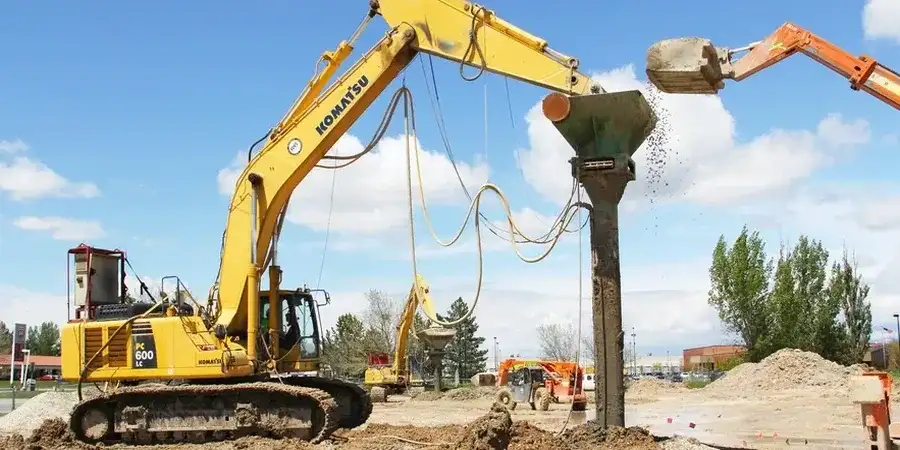
In Houston, the 15-ton vibrator unit, mounted on a mast and suspended from a crawler crane, is an electric model rated between 130 and 180 kW. Its eccentric weights spin at 1,800 rpm to induce compaction. These units are often deployed on pads located as close as 200 feet to active natural gas pipelines, which poses a significant hazard. The pore pressure pulse generated by compaction can spread laterally into adjacent layers of soft clay, temporarily reducing their strength. During a 90-minute compaction run on Beaumont clay, we have recorded immediate settlements of 3 to 5 inches nearby. Such movements are problematic if the neighboring infrastructure includes pipelines or tank farms. To mitigate this, our design incorporates pre-drilled relief holes and carefully ordered compaction passes to direct excess pore water toward free-draining zones. For any Houston site within 100 feet of infrastructure, we routinely perform post-treatment monitoring with piezometers. Additionally, a minimum waiting period of 48 hours is mandated before beginning foundation excavation.

Need a geotechnical assessment?

Reply within 24h.

Email: contact@geotechnicalengineering1.org

Reference standards


The applicable codes and standards include IBC Chapter 18 for soils and foundations, FHWA-NHI-06-089 for improvement methods, ASTM D1586 for the Standard Penetration Test, ASTM D2487 for soil classification, and ASCE 7-22 for minimum design loads.

Technical data

ParameterTypical value
Target relative density (Dr)≥70% post-treatment
Maximum fines content treatable≤18% (with water flush)
Typical probe spacing6 to 10 ft triangular grid
Design vibrator power130–180 kW electric or hydraulic
Verification methodCPT before/after at 25% of probe points
Settlement tolerance<1 inch total, <0.5 inch differential
Peak particle velocity limit0.5 in/sec at 50 ft (urban)

Questions and answers


How much does vibrocompaction design cost for a Houston warehouse site?

The cost of a design package for a typical 2- to 5-acre commercial pad in Houston ranges from US$1,320 to US$4,860. This variation depends on the quantity of borings, CPT soundings, and the intricacy of the grid layout. Sites near pipelines or with irregular boundaries incur higher costs due to the additional monitoring and sequencing analysis required.

How deep can vibrocompaction effectively treat Houston’s soils?

Effective treatment depths in Houston's geology are between 20 and 50 feet, with the Beaumont clay layer being the primary limiting factor. When the vibrator encounters this stiff, overconsolidated stratum, penetration ceases. The treatment bottom is established at the sand-clay interface, as determined from CPT pore pressure dissipation tests.

What’s the minimum site size for vibrocompaction to be practical in Houston?

Compaction grids have been designed for pads as small as half an acre. For areas smaller than that, the cost of mobilizing the crawler crane and vibrator makes this technique less economical than overexcavation followed by controlled fill replacement. To ensure safe crane maneuvering, the access width must be at least 40 feet.

Location and service area

We serve projects across Houston and surrounding areas.

View larger map