GEOTECHNICAL ENGINEERING
HOUSTON
HomeSlopes & WallsActive/passive anchor design

Active and Passive Anchor Design for Houston’s Gulf Coast Soil Conditions

Evidence-based design. Reliable delivery.

LEARN MORE

Houston’s geology tells a story of high-plasticity Beaumont clays and a water table that sits just a few feet below the surface. When you excavate for a parking garage in Midtown or a flood control structure near Buffalo Bayou, the lateral earth pressures don’t behave like they do in rock. The expansive clay cycles between saturated and desiccated, and that seasonal movement can compromise a conventional retaining wall in under two years. We specify active and passive anchor systems that work with this soil behavior, not against it. The anchor bond zone is sized using actual site data from in-situ permeability testing and SPT blow counts, so we target load capacities that hold through Houston’s brutal August soakings and the dry winter contraction periods alike.

In Houston’s Beaumont clay, anchor bond stress is governed by drained shear strength, not short-term undrained cohesion. Designing for the drained condition prevents creep failure.
Our service areas

Process overview

The most expensive mistake we see in Houston excavation projects is assuming a passive pressure envelope based on textbook cohesion values. Around the Energy Corridor, where the subsurface shifts from stiff clay to silty sand lenses within 20 vertical feet, a generic design fails because the assumed failure wedge doesn't match the stratification. Our design approach builds the ground model from CPT test pore pressure dissipation and lab-derived drained shear strength. We then run limit equilibrium analyses for the temporary shoring condition and the permanent wall condition, specifying unbonded lengths that extend well beyond the critical slip surface. For active anchors, we apply a lock-off load calibrated to limit wall deflection to under 0.5 inches during the first year of service. Every tendon and bearing plate is sized per ACI 318 Chapter 17 anchorage provisions and FHWA Geotechnical Circular No. 4 guidelines.
Active and Passive Anchor Design for Houston’s Gulf Coast Soil Conditions
Technical reference — Houston

Local context

Following Hurricane Harvey, Houston's building surge extended into zones with suboptimal soil conditions, ranging from the soft organic deposits along Greens Bayou to the sandier formations near Katy. Given the city's flat terrain and clay-rich geology, even a 15-foot excavation can lead to a base heave failure if the passive resistance zone lacks adequate reinforcement. Anchor systems in such settings must counteract not only static earth pressure but also transient loads from nearby traffic on FM 1960 and vibrations from pile driving on adjacent lots. A passive anchor failure in a single soldier pile doesn't merely cause a schedule delay; it may escalate into a global stability failure that undermines the roadway and damages utility lines. Every anchor design package we deliver includes a constructability review to confirm the contractor can achieve the necessary unbonded length within the site's accessibility limitations and that the grout-to-ground bond remains intact in the local sulfate-rich groundwater.

Need a geotechnical assessment?

Reply within 24h.

Email: contact@geotechnicalengineering1.org

Visual overview


Reference standards

FHWA Geotechnical Circular No. 4 (Ground Anchors and Anchored Systems), PTI DC35.1-14 (Recommendations for Prestressed Rock and Soil Anchors), ASTM A416 / A416M (Low-Relaxation Strand), ASTM D3689 (Static Axial Tensile Load Test for Anchors), ACI 318-19 Chapter 17 (Anchorage to Concrete), and IBC 2021 Chapter 18 (Soils and Foundations) are the applicable standards.

Technical data


ParameterTypical value
Design methodologyLimit equilibrium (FHWA GEC No. 4) + AASHTO LRFD 11th Ed.
Anchor typeActive (prestressed) and passive (reaction) tiebacks
Tendon steel gradeASTM A416 Grade 270 (low-relaxation strand)
Typical bond length (clay)12 to 35 ft, verified by load test
Corrosion protectionClass I (double encapsulation) per PTI DC35.1
Load test protocolPerformance test (cyclic) per ASTM D3689
Proof load133% of design load (active anchors)
Design life75 years (permanent) / 24 months (temporary excavation)

Questions and answers

What's the difference between active and passive anchors for a Houston excavation?

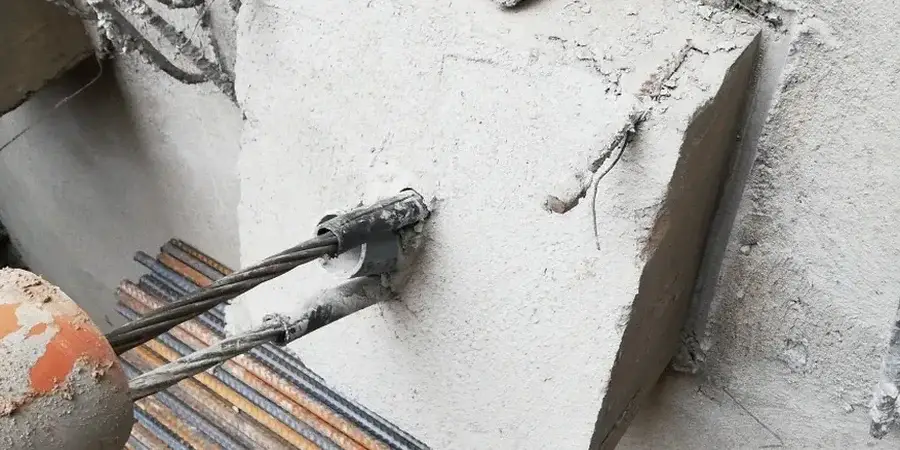
Active anchors are prestressed to a specified lock-off load right after the grout achieves required strength, actively restraining the wall and controlling movement from the start. Passive anchors, in contrast, are not prestressed; they only generate resistance as the wall deflects and the soil mass shifts. For permanent walls in Houston's stiff Beaumont clay where deflection must be limited to less than half an inch, we typically opt for active anchors. For temporary cuts or slope stabilization where some movement is permissible, passive anchors are chosen.

Does the high groundwater table in Houston affect anchor design?

Absolutely. Across much of Harris County, the water table lies within 5 to 10 feet of the surface. We design the bond zone below the phreatic surface using effective stress parameters, not total stress. The grout mix must remain stable under wet conditions, and for any permanent anchor installed in groundwater, we mandate double-corrosion protection (Class I). To prevent moisture ingress into the strand over the 75-year design life, the anchor head is fitted with a watertight cap.

What does anchor design cost for a project in Houston?

Professional fees for active and passive anchor design generally range from US$1,160 to US$3,340, depending on anchor count, soil profile complexity, and the required load testing program. A straightforward temporary shoring wall with a single row of passive anchors falls at the lower end. A multi-level tiedback wall for a deep basement requiring performance testing on every anchor and corrosion protection detailing will be at the upper end.

Location and service area

We serve projects across Houston and surrounding areas.

View larger map