GEOTECHNICAL ENGINEERING
HOUSTON
HomeExcavationsGeotechnical analysis for soft soil tunnels

Geotechnical Analysis for Soft Soil Tunnels in Houston

Evidence-based design. Reliable delivery.

LEARN MORE

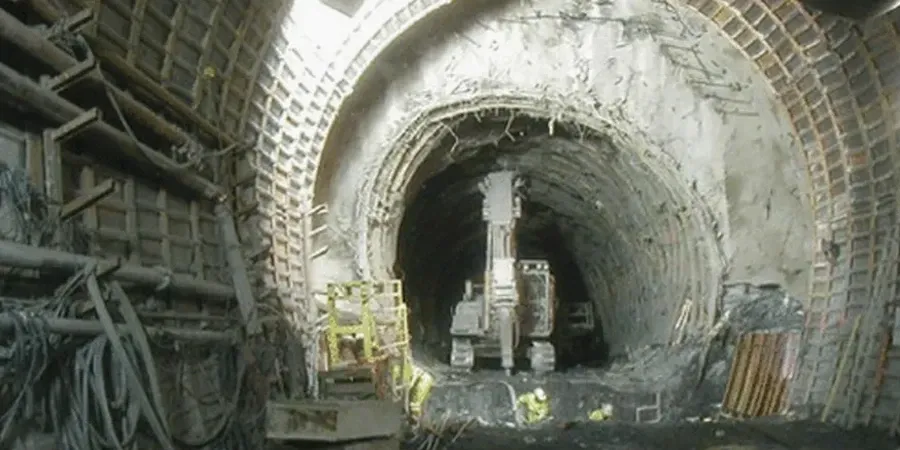
The subsurface contrast between downtown Houston and the Energy Corridor is striking once you go below grade. Near Buffalo Bayou, you hit soft, high-plasticity Beaumont clays within the first ten feet, while further west toward Katy the Pleistocene terraces show more overconsolidated behavior. That difference dictates everything for a tunnel boring machine: face pressure, cutterhead torque, and the real risk of squeezing ground. Our Houston lab runs the full suite of classification and strength tests needed before anyone orders a TBM. We process Shelby tube samples from the same Gulf Coast formations that have challenged every major underground project in this city, and we pair standard index work with advanced triaxial and consolidation testing. For deeper tunnel alignments, the CPT testing data often supplements the boring logs, letting us correlate tip resistance directly with undrained shear strength in the normally consolidated clays that dominate Houston's subsurface.

In Houston's Beaumont clays, a plasticity index above 40 combined with a water table at six feet changes the entire tunnel support philosophy.
Our service areas

Process overview

Houston sits on a thick package of Quaternary clays and silts, with the water table often perched just five to eight feet below the surface. That shallow groundwater, combined with the normally consolidated to lightly overconsolidated nature of the Beaumont Formation, means tunnel crown stability is always a live question. We run CU and UU triaxial series at confining pressures that match the alignment's overburden, and we report both total and effective stress parameters because the designer needs both for short-term face stability and long-term lining loads. Consolidation tests follow ASTM D2435 with load increments up to 32 tsf, capturing the full recompression and virgin compression curves. When the samples show interbedded silt lenses, which is common in the Lissie Formation north of I-10, we add falling-head permeability on trimmed specimens to give the dewatering contractor real numbers. The lab also runs Atterberg limits on every tube, because the plasticity index in Houston's fat clays regularly exceeds 40 and that drives the squeeze potential calculations.
Geotechnical Analysis for Soft Soil Tunnels in Houston
Technical reference — Houston

Local context

In Houston, the combination of high humidity and regular stormwater flooding creates a danger that those not residing along the Gulf Coast often fail to appreciate: transport-induced sample disturbance from either drying out or absorbing moisture. Consider a Shelby tube extracted from a depth of fifty feet in the Addicks vicinity; if left on a rig floor during the August heat, its structure can deteriorate rapidly. Our facility enforces a rigorous chain-of-custody procedure, utilizing insulated transport containers and same-day extrusion for all delicate specimens. Another frequent oversight is taking a desiccated surface crust as typical of the deeper strata—we observe this repeatedly in the Upper Beaumont formation, where the surface clays are stiff and cracked, yet the tunnel horizon remains soft and normally consolidated. A comprehensive dataset from lab tests, extending beyond just SPT blow counts, is what differentiates the crust from the actual tunneling material. Furthermore, since Houston lies within a region of low seismic activity, liquefaction seldom governs the design; nevertheless, we highlight cyclic softening in high-plasticity clays under repetitive TBM loading whenever lab results indicate sensitivity ratios exceeding four.

Need a geotechnical assessment?

Reply within 24h.

Email: contact@geotechnicalengineering1.org

Visual overview


Reference standards

We adhere to several ASTM standards including D2487 for soil classification, D4767 for consolidated undrained triaxial tests on cohesive soils, D2435 for one-dimensional consolidation, D4318 for Atterberg limits, and D5084 for hydraulic conductivity using a flexible wall permeameter.

Technical data


ParameterTypical value
Soil classification (USCS)ASTM D2487 visual-manual + lab validation
Undrained shear strength (Su)UU triaxial, Torvane, pocket penetrometer
Effective stress parametersCU triaxial with pore pressure measurement (c', φ')
Consolidation (mv, cv, Pc)ASTM D2435 oedometer, load range 0.5–32 tsf
Plasticity indexASTM D4318 Atterberg limits
Natural water contentASTM D2216 oven drying
Permeability (intact specimen)ASTM D5084 falling head, flexible wall
Unit weightASTM D7263 bulk density by dimensions

Questions and answers

What is the typical turnaround for a consolidation test on Houston clays?

For a typical incremental consolidation test per ASTM D2435, each specimen requires roughly five to seven business days to complete, provided the sample arrives in sound condition. Our practice involves applying load steps that double every 24 hours until reaching the specified maximum overburden stress, and we can include unloading-reloading cycles upon request. Should a project demand a quicker outcome via CRS consolidation, we are capable of performing that method; however, our laboratory still considers the standard incremental test as the benchmark for determining the preconsolidation pressure.

Do you test both total and effective stress parameters for tunnel design?

Absolutely. To derive effective stress parameters (c' and φ') for long-term lining design and drained stability evaluations, we perform consolidated-undrained triaxial tests that include pore pressure measurements. Additionally, we conduct unconsolidated-undrained tests to obtain the undrained shear strength (Su) profile, which governs short-term face stability and TBM operational settings. Our laboratory reports both sets of data in the same documentation.

How much does a full geotechnical lab program for a soft ground tunnel cost?

For a comprehensive laboratory program along a tunnel alignment in Houston's soft clay deposits, costs generally fall between US$4,650 and US$16,260, varying with the quantity of samples, the alignment depth, and the balance between classification and advanced testing. If a project involves one hundred Shelby tubes with a complete triaxial and consolidation suite on chosen specimens, the cost will be at the higher end; conversely, a more limited investigation emphasizing targeted index testing will be at the lower end.

Can you handle samples from deep tunnel alignments below the water table?

Certainly. Our facility handles Shelby tube and piston samples taken from depths greater than 150 feet, a typical requirement for Houston's large-diameter drainage and transit tunnels. The critical factors are preserving the in-situ stress condition and avoiding moisture loss throughout extrusion and specimen trimming. To achieve this, we employ trimming rooms with controlled humidity and store specimens that cannot be tested within the same day under wax-sealed conditions.

What lab data do you provide for squeeze potential assessment in plastic clays?

For squeeze potential analysis, we supply all requisite parameters: natural water content, Atterberg limits, liquidity index, undrained shear strength derived from UU triaxial tests or handheld devices, and consolidation information such as preconsolidation pressure and compression index. Whenever the liquidity index surpasses 0.8 and the plasticity index exceeds 30, we explicitly mark those intervals, enabling the tunnel engineer to perform convergence-confinement analyses using soil parameters grounded in actual laboratory measurements.

Location and service area

We serve projects across Houston and surrounding areas.

View larger map