GEOTECHNICAL ENGINEERING
HOUSTON
HomeIn-SituField density test (sand cone method)

Field Density Testing in Houston – Sand Cone Method for Soil Compaction Control

Evidence-based design. Reliable delivery.

LEARN MORE

Houston’s geology isn’t forgiving. The city sits on the Beaumont Formation – thick Pleistocene clays that swell when wet and shrink to a brick-like hardness during our long, dry summers. Anyone who’s managed a site near Buffalo Bayou or out toward Katy knows the drill: you move dirt, you compact it, and then the Houston humidity creeps in overnight and changes everything. That’s where field density testing with the sand cone method earns its keep. Based on ASTM D1556, it gives you a direct measurement of in-place density – no nuclear gauges, no calibration drift, just a straightforward volume-replacement check that tells you whether the lift you just rolled actually meets spec. For Houston earthwork contractors building on fat clays with plasticity indices north of 30, the sand cone test is often the referee that settles the argument between the grader and the geotech. When we run a sand cone density test on a building pad in the Energy Corridor or a trench backfill under I-10, we’re looking at percent compaction relative to a lab Proctor curve – and in these soils, missing by two percent can mean the difference between a slab that stays flat and one that heaves after the first summer rain.

In Houston’s fat clays, a two-percent compaction shortfall can be the difference between a slab that stays flat and one that moves with every summer rain.
Our service areas

Process overview

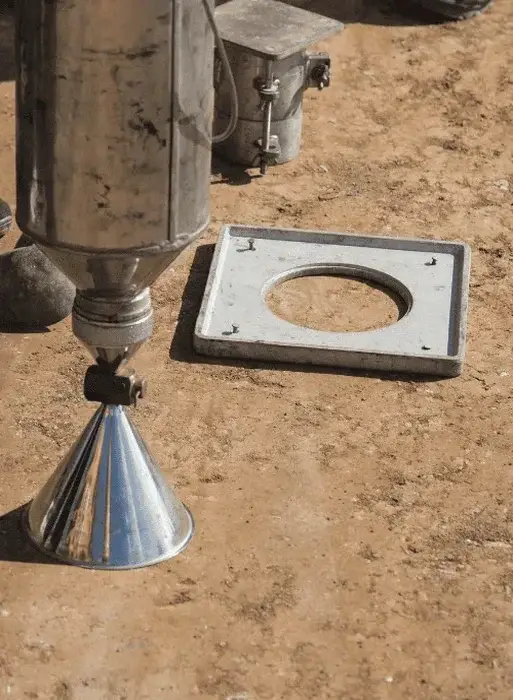
Houston’s near-surface soils are predominantly high-plasticity CH clays – the kind that stick to your boots and make a mess of a compaction operation if you’re not careful with moisture control. Groundwater sits high across much of the metro area, often within 1.5 to 3 meters of grade, which means fill placement frequently happens within the capillary fringe. The sand cone procedure we run on Houston sites follows ASTM D1556 step by step: we excavate a small test hole, capture all the removed soil for mass determination, then backfill the cavity with calibrated Ottawa sand flowing through a standard cone and valve assembly. The volume is calculated from the mass of sand used, and the wet density falls right out. We oven-dry the excavated material to get moisture content – critical here, because Houston clays can hold 25–30% water and still look dry on the surface. A Proctor test run on the same material in the lab gives us the maximum dry density and optimum moisture, and the field result is reported as a percentage of that standard Proctor value. On Harris County commercial projects, specs typically demand 95% of standard Proctor under slabs and 90–95% in landscape areas, though the number moves depending on the structural engineer’s recommendations and the specific risk profile of the expansive clay. The test takes about 20–30 minutes per point, and you get a result before the next truck of fill arrives – that immediacy is what keeps grading crews productive and off the back foot with the inspector.
Field Density Testing in Houston – Sand Cone Method for Soil Compaction Control
Technical reference — Houston

Local context

Houston’s expansive clays don’t announce themselves until it’s too late. We’ve seen projects where fill was placed a few points dry of optimum, the density test passed at 96%, and six months later the building started moving because the clay finally hydrated and swelled under the foundation. The sand cone test captures density – it doesn’t directly measure soil suction or future volume change – so interpreting the moisture data alongside the density number is what separates a box-ticking exercise from real quality control. Another headache specific to this region: variable fill sources. A lot of Houston commercial pads are built with imported select fill that’s supposed to meet a PI spec, but the material arriving on site can change from one borrow pit to the next. Running a Proctor test on each new material and pairing it with sand cone checks keeps the compaction target honest. Trenches are their own beast – utility backfill in Houston’s gumbo clays tends to settle differentially if the moisture isn’t controlled during compaction, and a sand cone test in the trench bottom can reveal a soft spot before the pipe goes in and the asphalt goes down.

Need a geotechnical assessment?

Reply within 24h.

Email: contact@geotechnicalengineering1.org

Reference standards


Key standards referenced include ASTM D1556 and D698, AASHTO T-191, and IBC Chapter 18. The first and third deal with sand-cone density testing, while ASTM D698 covers laboratory compaction. IBC Chapter 18 specifies requirements for soils and foundations.

Technical data

ParameterTypical value
Applicable standardASTM D1556 / AASHTO T-191
Typical test depth100–150 mm (4–6 in) – lift thickness dependent
Test duration per point20–30 minutes, result available on site
Soil types suitableClays, silts, sandy clays; max particle size approx. 38 mm
Common Houston spec range90–98% of standard Proctor (ASTM D698)
Moisture condition checkOven-dry moisture content ±2% of optimum typical
Calibration sandGraded Ottawa sand, bulk density verified per ASTM D1556 Annex
Reporting formatWet density, dry density, % compaction, moisture content

Questions and answers


How much does a field density test with the sand cone method cost in Houston?

Most earthwork projects schedule multiple points per day, reducing the per-unit cost to the lower end of the range. For a standard ASTM D1556 sand cone test in Houston, pricing typically ranges from US$90 to US$140 per point, influenced by mobilization count and travel distance. This price covers the field test, oven-dry moisture determination, and density calculation reported as a percentage of the lab Proctor maximum.

Why use the sand cone method instead of a nuclear density gauge in Houston clays?

The sand cone method offers a direct volume measurement without radiation or calibration issues, making it advantageous in Houston's Beaumont clays where nuclear gauges may be biased by hydrogen content. On sites with diverse fill sources or variable moisture, this method often provides a more defensible value when challenged.

How many sand cone tests do I need for a building pad in Houston?

Several factors dictate the test count: pad area, lift thickness, and project specifications. In Harris County, a typical guideline for commercial pads is one test for every 2,500 to 5,000 square feet per lift, with at least three tests per lift irrespective of area. The earthwork specification's frequency is usually determined by the structural engineer or geotechnical consultant, and we modify the testing grid in response to observed variability during compaction.

Does the sand cone test work in gravelly or rocky Houston soils?

ASTM D1556's standard sand cone method applies only to soils with a maximum particle size of approximately 1.5 inches (38 mm). In Houston, the majority of near-surface fills consist of clay, sandy clay, or silty clay, all of which easily meet this criterion. However, if areas with substantial gravel content are encountered—such as in older reworked fill near the Ship Channel or certain crushed-limestone base courses—we might suggest a larger-volume replacement test or an additional method to obtain a representative density measurement.

Location and service area

We serve projects across Houston and surrounding areas.

View larger map