GEOTECHNICAL ENGINEERING
HOUSTON
HomeLaboratoryProctor test (Standard or Modified)

Proctor Test (Standard and Modified) in Houston – ASTM D698 and D1557 Compaction Control

Evidence-based design. Reliable delivery.

LEARN MORE

A common mistake on Houston construction sites is assuming the black gumbo clay native to the Gulf Coast Prairie will respond to compaction the same way as a clean sand from the Willis Formation. When a contractor runs the wrong Proctor effort on fat clay with liquid limits above 50, the resulting density target can be unachievable in the field, or worse, it masks a moisture sensitivity that triggers differential heave later. Our team steps in before the pads are cut: we run the Atterberg limits first to classify the material, then select Standard or Modified Proctor per ASTM D698 or D1557 to build a moisture-density curve that actually fits the borrow source. In a metro area spanning four counties where fill quality swings from Beaumont clay to Pleistocene terrace sand, getting the compaction specification right is not just a QA checkbox; it determines whether the slab stays flat through the next drought cycle.

Selecting the wrong Proctor effort for Houston\'s fat clays can set a density target that is either unattainable or masks the moisture sensitivity that drives slab heave.
Our service areas

Process overview

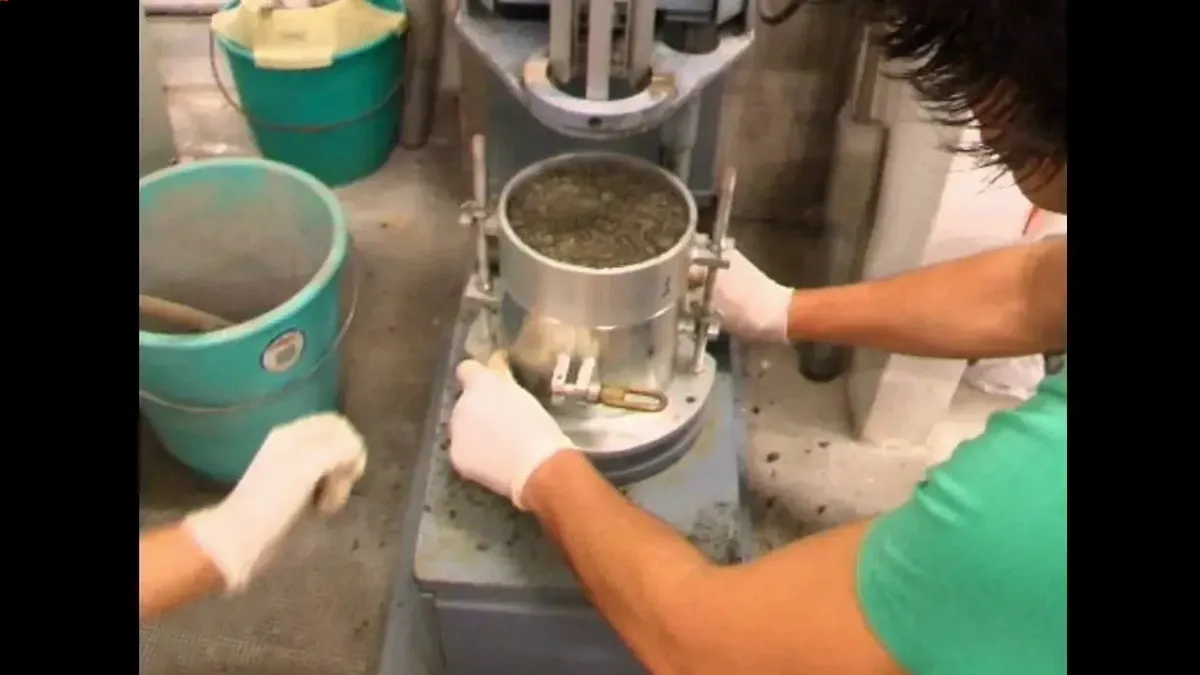
Across Houston, the contrast between a site near Buffalo Bayou and one out in Katy can be stark. Downtown and inside Loop 610, you are often dealing with over-consolidated Beaumont Formation clays that have been preloaded by geologic history; they compact predictably under Modified effort but demand strict moisture control within 2 percent of optimum. West of Beltway 8, the Lissie and Willis formations deliver silty sands that drain fast and hit maximum density at lower moisture, making Standard Proctor more representative of field roller energy. We calibrate the method to the material: Standard Proctor uses a 5.5-lb hammer dropped 12 inches in three layers, while Modified Proctor applies a 10-lb hammer dropped 18 inches in five layers, quadrupling the compactive effort. For sites with mixed fills, we often pair Proctor curves with sand cone density tests to verify that field compaction exceeds 95 percent of the laboratory maximum, a threshold written into most City of Houston public works specifications.
Proctor Test (Standard and Modified) in Houston – ASTM D698 and D1557 Compaction Control
Technical reference — Houston

Local context

The city of Houston, perched about 80 feet above sea level, lies on Quaternary-era sediments prone to volume changes with seasonal precipitation. During Hurricane Harvey in 2017, over 50 inches of rain fell, followed by summers that nearly dried out the clay to depths of 10 feet. Lacking a proper Proctor curve, a structural fill placed wet of optimum can background a 15 to 20 percent reduction in strength as suction is lost, leading to settlement after construction beneath grade beams and pavements. This danger increases in flood-vulnerable areas like Greenspoint or Meyerland, where FEMA 500-year floodplains overlie expansive Beaumont clay; in such settings, density alone does not ensure stability. We supply optimum moisture and maximum dry density along with one-point Proctor checks during construction, enabling the earthwork contractor to tweak rolling patterns before the nuclear gauge indicates low density. The Harris County standard of care, reinforced by the IBC and ASCE 7, directly links foundation performance to documented compaction.

Need a geotechnical assessment?

Reply within 24h.

Email: contact@geotechnicalengineering1.org

Visual overview


Reference standards

Essential references include ASTM D698-12 (Standard Proctor), ASTM D1557-12 (Modified Proctor), IBC 2021 Chapter 18 on Soils and Foundations, ASCE 7-22 Section 12.13 for Geotechnical Investigation, and the City of Houston Infrastructure Design Manual governing fill compaction.

Technical data


ParameterTypical value
Standard Proctor hammer mass5.5 lb (2.5 kg)
Standard Proctor drop height12 in (305 mm)
Modified Proctor hammer mass10 lb (4.54 kg)
Modified Proctor drop height18 in (457 mm)
Standard Proctor layers per mold3
Modified Proctor layers per mold5
Mold volume (4-inch)0.0333 ft³ (944 cm³)
Typical max. dry density range (Houston fat clay)92 – 108 pcf

Questions and answers

How much does a Proctor test cost in Houston?

A Standard or Modified Proctor test typically costs between 100 and 200 US dollars, influenced by whether Atterberg limits or grain-size analysis are added. The ultimate expense hinges on the number of borrow sources requiring separate curves; for instance, a project with three distinct fill materials demands three Proctor tests.

When should I use Modified Proctor instead of Standard Proctor?

Modified Proctor is employed when fill will bear structural loads under pavements, commercial slabs, or bridge approaches compacted with heavy vibratory rollers. Standard Proctor suits landscaping berms, shallow residential backfill, or trench backfill where hand-operated equipment is used. In Houston, the choice follows the geotechnical specification, commonly aligned with the City Infrastructure Design Manual or Harris County Toll Road Authority standard details.

Location and service area

We serve projects across Houston and surrounding areas.

View larger map