GEOTECHNICAL ENGINEERING
HOUSTON
HomeLaboratoryTriaxial test

Triaxial Testing in Houston: Shear Strength Data for Gulf Coast Soils

Evidence-based design. Reliable delivery.

LEARN MORE

Houston's geotechnical profile is a tale of two formations: the stiff Beaumont clays west of downtown and the younger, compressible deposits tracing Buffalo Bayou's historic floodplain. Designing anything from a Westchase mid-rise to a Ship Channel tank farm without resolving effective friction angle (φ') and cohesion (c') is a gamble. We run consolidated-undrained (CU) and consolidated-drained (CD) triaxial tests to give structural engineers the exact parameters needed for bearing capacity and slope stability models. When a site hits those gray, fat clays at 15 feet, we often pair the triaxial data with a grain-size analysis to confirm fines content, since Houston's Beaumont Formation can swing from sandy lean clay to high-plasticity fat clay within a single boring. The I-10 corridor alone has enough soil variability to make textbook assumptions dangerous.

In Houston's Beaumont Formation, the difference between φ'=26° and φ'=30° can change a retaining wall design from a cantilever to a tieback system. That's the value of a proper triaxial test.
Our service areas

Process overview

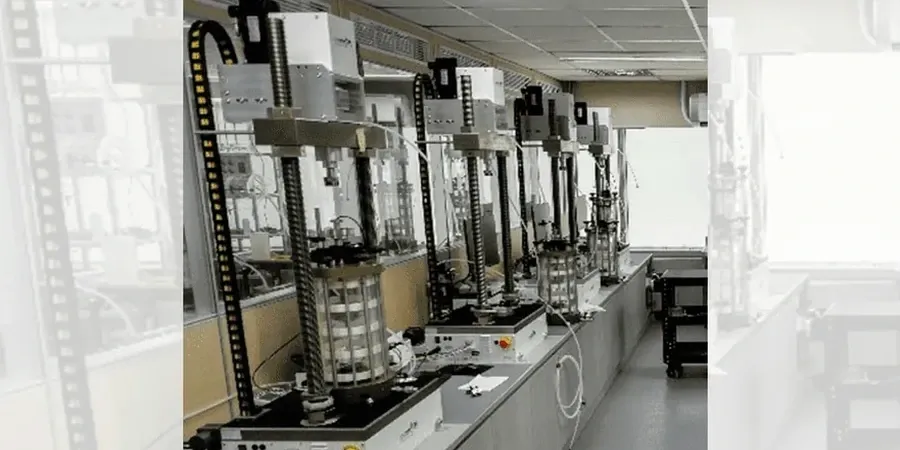
Houston's unzoned growth pushed deep foundations into areas where Pleistocene terraces meet Holocene backswamp deposits. The triaxial test became a non-negotiable requirement for public works after the Texas Department of Transportation formalized its geotechnical manuals in the 1990s. We run three primary protocols: unconsolidated-undrained (UU) for short-term stability during excavation, consolidated-undrained with pore pressure measurement (CUPP) for embankment construction over soft clay, and consolidated-drained (CD) for long-term settlement analysis in clean sands. Sample preparation follows ASTM D4767 and D7181, with back-pressure saturation achieving Skempton B-values above 0.95 before shear. A typical 2.8-inch diameter specimen sheared at 0.5% strain per minute yields a full Mohr-Coulomb envelope in five to seven working days. For Houston's typical Beaumont clay, effective friction angles usually land between 24 and 32 degrees, depending on overconsolidation ratio. We report total and effective stress paths, pore pressure response, and failure mode photographs.
Triaxial Testing in Houston: Shear Strength Data for Gulf Coast Soils
Technical reference — Houston

Local context

In Houston, we've analyzed numerous foundation failures where the true issue wasn't the concrete itself but an inflated cohesion value derived from hand penetrometer tests. The triaxial test eliminates this uncertainty by accurately assessing the soil skeleton's response under controlled drainage conditions. Take, for instance, a detention basin excavation near Brays Bayou: if the contractor assumes fully drained conditions during a rapid drawdown event, bottom heave can surpass six inches overnight—a scenario we've observed firsthand. The CUPP test captures both the undrained shear strength (Su) and the excess pore pressure development, which together determine the safe rate of excavation. For pile design in the Energy Corridor's deep, soft clays, a CD test on a remolded specimen yields the critical-state friction angle required by API RP 2GEO and FHWA drilled shaft methods. Neglecting triaxial data means relying on a factor of safety that exists only in theory.

Need a geotechnical assessment?

Reply within 24h.

Email: contact@geotechnicalengineering1.org

Reference standards


The relevant standards include ASTM D4767-11 for consolidated undrained triaxial compression testing of cohesive soils, ASTM D7181-20 for consolidated drained triaxial compression testing, ASTM D2850-15 for unconsolidated-undrained triaxial compression testing on cohesive soils, AASHTO T-297 for consolidated undrained triaxial compression testing, and USACE EM 1110-2-1906 for laboratory soils testing (triaxial procedures).

Technical data

ParameterTypical value
Test standardsASTM D2850, D4767, D7181
Confining pressures (typical)5, 10, 20 psi (higher for deep wells)
Specimen diameter2.8 in (71 mm) or 4.0 in (102 mm)
Saturation methodBack-pressure, target B-value ≥0.95
Strain rate (CU/CD)0.3% to 1.0% per minute
Reported parametersφ', c', φ_total, c_total, E50, stress path
Typical turnaround5–7 working days (expedited available)
Specimen trimmingLathe-trimmed in humid room to preserve natural moisture

Questions and answers


What is the cost of a triaxial test in Houston for a commercial building project?

A typical set of three triaxial tests (UU or CUPP) on cohesive soil costs between US$1,810 and US$3,080, with the final price depending on confining pressures and whether effective stress reporting is required. Multi-stage tests or CD tests on sands fall at the upper end of that range. After reviewing the Shelby tube recovery and project specifications, we supply a fixed-price quotation.

How does the triaxial test differ from the unconfined compression test we usually see in Houston reports?

The unconfined compression (UC) test is conducted at zero confining pressure and is suitable only for intact cohesive samples. In contrast, a triaxial test applies lateral confinement, replicating the in-situ stress state at depth. For Houston's overconsolidated Beaumont clay, the UC test overestimates shear strength in shallow zones and fails to capture the effective stress envelope essential for slope stability analysis. When designing permanent retaining structures or deep excavations below the water table, the triaxial test is obligatory.

Can you perform triaxial tests on sandy samples from the Houston Ship Channel area?

Absolutely. We perform consolidated-drained (CD) tests on reconstituted sand specimens in accordance with ASTM D7181. For silty sands from the Beaumont or Lissie formations, we employ the moist tamping method to attain the target relative density. This test yields the effective friction angle at critical state, which is directly used in FHWA drilled shaft design software and liquefaction triggering analyses.

Location and service area

We serve projects across Houston and surrounding areas.

View larger map