GEOTECHNICAL ENGINEERING
HOUSTON
HomeInvestigationExploratory test pit

Exploratory Test Pits in Houston: Direct Subsurface Verification for Gulf Coast Soils

Evidence-based design. Reliable delivery.

LEARN MORE

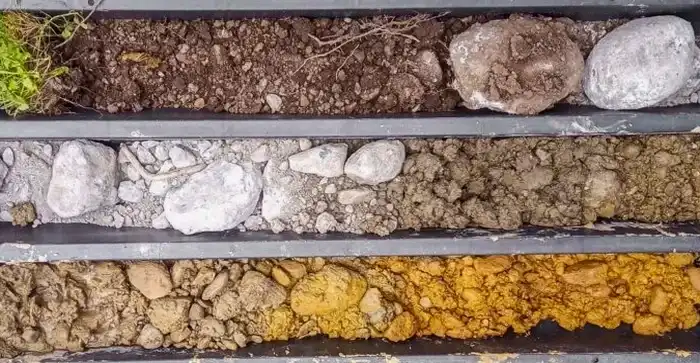
Houston's geology doesn't read like a textbook. The Beaumont Formation clays shift with every rainless summer, then swell again when tropical moisture rolls in from the Gulf. Foundation engineers here learn fast that borings alone don't always tell the full story. An exploratory test pit opens a window into the upper five to fifteen feet where most residential and light commercial footings will bear. You see the desiccation cracks, the sand seams, the fill zones that a split-spoon sample can miss. When we excavate a pit in a Montrose yard or a Katy detention basin, we log the profile directly against ASTM D2488, photograph the stratigraphy, and pull bulk samples for Atterberg limits and Proctor compaction work. For deeper bearing assessment beyond the pit floor, we often follow up with SPT drilling to tie surface observations to blow counts at depth. The result is a ground truth that complements every other subsurface method on the table.

A test pit doesn't just sample the soil. It exposes the stratigraphic story that a boring log can only sketch in dotted lines.
Our service areas

Process overview

Houston's expansion from the 1960s onward pushed development across broad swaths of Pleistocene terrace deposits and recent fluvial clays. That history left a legacy of variable fill thicknesses and undocumented utility trenches that show up only when a backhoe opens the ground. A test pit program in the Energy Corridor or near Buffalo Bayou reveals layering that governs infiltration rates and bearing pressure assumptions. Our crews typically advance pits to 12 feet in stable ground, benching or sloping sidewalls per OSHA Subpart P. The in-situ visual examination records moisture condition, plasticity, color mottling, and root penetration. Bulk sampling from each distinct horizon allows the lab to run grain-size distribution and plasticity index tests, tying field descriptions to engineering classification. Where shallow groundwater appears, we note the seepage depth and can coordinate in-situ permeability testing during the same mobilization. Every logged pit becomes a permanent record for the geotechnical report, with GPS coordinates tied to the project's site plan.
Exploratory Test Pits in Houston: Direct Subsurface Verification for Gulf Coast Soils
Technical reference — Houston

Local context

In Houston, we've observed numerous instances where neglecting test pits resulted in unexpected findings during footing excavation—such as a Heights developer encountering a historic brick-lined cistern at a depth of four feet, or a warehouse pad near Greens Bayou sitting on uncompacted clay fill deposited after Hurricane Allison. Standard borings might have overlooked these issues. A well-designed test pit program is essential for identifying such anomalies. Additionally, perched groundwater in clay strata after significant rainfall is a common occurrence that pits reveal clearly, whereas dry-season borings might not detect it. The real-world risks include buried fill, organic seams, abandoned infrastructure, and hidden debris. Once excavation equipment exposes these materials, immediate engineering actions like recalculating bearing capacity, recommending over-excavation, or modifying foundation design are required. This is why test pits remain among the most straightforward and economically efficient exploration techniques in the greater Houston region.

Need a geotechnical assessment?

Reply within 24h.

Email: contact@geotechnicalengineering1.org

Reference standards


Standard practices include ASTM D2488 for visual-manual soil description, ASTM D420 for site characterization, and OSHA 29 CFR 1926 Subpart P for excavation safety.

Technical data

ParameterTypical value
Maximum excavation depth12–15 ft (standard backhoe)
Visual classification standardASTM D2488 / USCS
Sidewall protectionOSHA Subpart P (benching/sloping)
Sampling methodBulk disturbed + hand-carved block samples
Groundwater observationSeepage depth, rate, and stabilization noted
Typical pit width24–36 inches bucket
Backfill compactionLayered backfill with hand tamp or mechanical compactor

Questions and answers


How deep can a test pit go in Houston's clay soils?

For the stiff Beaumont Formation clays common in Houston, a typical backhoe can safely excavate to depths of 12 to 15 feet when using benched or sloped sidewalls as per OSHA standards. For deeper excavations, shoring or a transition to drilled boring methods becomes necessary.

What does an exploratory test pit cost in the Houston area?

In the Houston metropolitan area, the expense for a standard exploratory test pit including visual logging and sampling is generally between US$540 and US$720 per pit, influenced by excavation depth, site accessibility, and the quantity of samples taken.

How soon after excavation can we see the pit log?

Field logs, complete with photographs and a preliminary USCS classification, are typically delivered within 24 hours after excavation concludes. Final logs, which incorporate results from laboratory index testing, follow within three to five business days.

Do you backfill and compact the test pit after logging?

Absolutely. Every test pit is refilled in lifts using mechanical compaction with a hand tamper or plate compactor, and the ground surface is restored to as close to its original grade as feasible. For pits situated within building footprints, we maintain documentation of the backfilling procedure for the earthwork record.

Location and service area

We serve projects across Houston and surrounding areas.

View larger map